
For the past few years, the residents of Hassanabad in Hunza had started fearing the mountain stream that had been flowing beside their homes for generations. This village in Gilgit-Baltistan lies along the Karakoram Highway and the stream coming from the Shisper Glacier has been flowing through it for centuries. But in recent times, the increase in frequency of avalanches falling into the stream had started turning it into a potential precursor of disaster.
In July this year, the fear of Hassanabad’s residents turned into reality.
Malaika Bibi, a resident of the village, says the flood in the stream was so fierce that the ground itself began to collapse. The raging floodwater first swept away the highway and then her home. Seventeen other houses were also destroyed.
“We had built our house with the money earned through hard work and labour. Now, we have neither land nor the strength to rebuild the house. We are farmers but now we have neither crops nor fields for farming,” bemoans Bibi.
Her family could manage to save just their lives and a few precious belongings. Malaika is now living with her parents and three siblings in a tent, two kilometers from her village, provided by flood relief workers.
According to the Gilgit-Baltistan Disaster Management Authority (GBDMA), since the late July this year, at least 45 people have lost their lives in climate disasters across the province. Damage to crops, farmland, water channels, small hydropower stations, transmission lines, roads, bridges and infrastructure is being reported from left, right and centre, with no sign of halt in sight.
Eman Shah, special assistant to the chief minister (SACM) of Gilgit-Baltistan, admits that the situation is unprecedented and such conditions never went on a stretch for two consecutive months. He is simply flabbergasted.
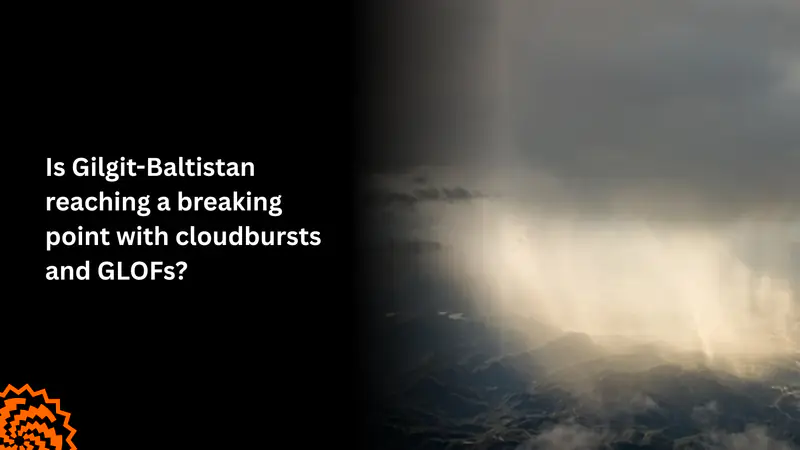
“The fatal combination of cloudbursts and glacial lake outburst floods (GLOFs) has caused widespread destruction. With very limited resources, our focus is yet on the rescue and emergency relief, while assessments of the damages are underway.”
According to Shehzad Baig, assistant director and admin coordinator at the GBDMA, cloudbursts are a new phenomenon for the region.
“In the past 15 years, only three such incidents were recorded here but now cloudbursts are happening almost every day now. These incidents have affected all districts of Gilgit-Baltistan, leaving no road safe, including the Karakoram Highway.”
Baig says Gilgit-Baltistan is home to more than 7,000 lakes with nearly three dozen of them, being glacial lakes, are highly dangerous because they can burst with the rise in temperatures and pressure, triggering major disasters.
A cloudburst is a climatic phenomenon and experts explain it in the following way.
Moist winds, when pushed upward along cool mountain slopes, condense into clouds that normally lead to rainfall. But if these clouds face intense and continuous pressure from warm, humid air rising from below, they are unable to release rain. Instead, water keeps building up inside them. The moment the pressure decreases or the clouds can no longer hold the load, they suddenly burst. In simple terms, a cloudburst means 100mm of rainfall (about 4 inches) within an hour or less time over an area of 20 to 30 square kilometers.
A glacial lake outburst flood (GLOF) literally means a flood caused by a glacial lake burst. Glaciers are vast sheets of ice that remain frozen year-round on high mountains. Pakistan’s largest glacier is Siachen, stretching 76km. It is the second largest non-polar glacier in the world. It is followed by Baltoro which is 63km long. According to a new study, Pakistan has more than 13,000 glaciers and they are primarily located in northern Gilgit-Baltistan and Khyber Pakhtunkhwa.
With rising temperatures, parts of these glaciers melt and form icy lakes. These lakes usually remain blocked by solid ice, rocks or debris. This is how many lakes turn into natural dams. But if the melting speeds up and more water flows into the lake or if the ice blocking its path begins to melt, the natural dam bursts. A mix of water, ice, rocks, and debris then rushes down the slopes with furious speed, sweeping away everything in its path. This phenomenon is called GLOF.
Dr Zainab Naeem, a climate expert, tells Lok Sujag that this year before the monsoon, the temperature in Gilgit-Baltistan was 6 to 7 degrees Celcius more than the average temperature which, on the one hand, led to the incidents of cloudbursts while on the other hand quickened the process of ice melting. She explains that the rise in the rate of glacier melting increases the pressure on the soil or soil layer frozen under the ice, which also starts sliding, causing glacial lakes to burst (GLOF).
She says that the cloudbursts and GLOFs in Gilgit-Baltistan are different in nature but the link between them is growing stronger. “Heavy rainfall caused by cloudbursts speeds up glacier melting and puts extra pressure on drainage systems. The weak points of glacial lakes cannot withstand this extra pressure and eventually burst.”
Dr Zainab explains that when a cloudburst and a GLOF occur simultaneously, one disaster amplifies the other. Torrents of rainwater, glacier ice and frozen soil debris rush downhill at a high speed, leading to major catastrophes.
Environmental expert Maryam Shabbir says that the problems of rapid melt of glaciers and GLOFs were already there but now their frequency is making life more difficult for the people of the region. She believes that the rate of temperature increase in mountainous areas is comparatively higher than in other regions and one significant cause of this climate change is the unregulated deforestation.
She emphasizes that the real issue is the unchecked emission of greenhouse gases at the global level.
“The world has failed to control the rise in temperature,” she points out.
In the 2015 Paris Agreement, all countries agreed to reduce greenhouse gas emissions to limit the global temperature increase to 1.5 degrees Celsius.
Dr Zainab Naeem says that the recent two-month-long floods in Gilgit-Baltistan show that the region’s weather patterns are changing in a major way.
“Floods for a short period used to occur in these areas earlier too, but now it seems that these continuous changes are taking the region to a long-term climate disaster,” she apprehends.
According to the GBDMA officials, part of the Shishper Glacier in Hassanabad has been breaking for years, and the danger still exists. However, this season there was no GLOF incident, all the damage was caused by cloudbursts.
However, Dr Zainab Naeem says the Environmental Protection Agency (EPA) and other departments of Gilgit-Baltistan work without proper coordination, which result in delays in disaster management efforts. “The lack of implementation of environmental laws and constructions in the river bed and stream pathways increases the risks. Early warning systems in the region are weak, and there is a severe shortage of technical expertise, real-time monitoring and funding. Local communities often have to rely on short-term donor projects, while these donor projects often overlook the local knowledge.”
Dr Zainab believes that national and regional environmental policies in the country are fragmented. The National Climate Change Policy and the National Adaptation Plan mention GLOF but they remain ineffective due to poor implementation.
She says that disaster risk reduction (DRR) should be a central part of the climate policy but it is often treated as a humanitarian or post-disaster measure. To address these weaknesses in Gilgit-Baltistan, she calls for an effective strategy to bring together technology, infrastructure, natural systems and local community.